Tuesday, October 2, 2012

Math & Science Easy to make games!

This game is called Creepy Critters.  Using a solid colored manilla envelope you choose a theme and then choose the skill you want the students to work on.  This particular game is used to work on patterning.  On the inside of the folder there are 12 caterpillars each with a different pattern.  Off to the sides of the folder there are 12 individual pieces that match the caterpillars on the folder.  Enrichment: To make this game more difficult for students who are not challenged make make the same patterns but in different colors.  Then the students truly need to focus on the pattern instead of just matching colors.  


For this game there are 10 dog houses and 10 dogs.  Each house and each dog has a number on it.  Children must match the dog to its numbered house.  To make this game dog houses and the dogs were printed out, colored and then covered and sealed in clear contact paper. 


The game "Funny Farm" is a matching game that teaches the appearances of animals.  On the folder you can see the tails of each animal on the farm, and you are required to match the face of the animal to the tail.  Enrichment: For a child beginning to recognize letters, you could add the first letter of each animal as an individual piece that the child must lay near the completed animal to work on letter recognition as well as animal recognition.                                                                                      


In this game "The Cookie Jar" there are "cookies" with shapes on them and their are corresponding shape is printed on the cookie jar.  The goal is to put all the cookies onto their respective jars.  Once all of the shapes are sorted count each jar to find out how many cookies are in each.  Enrichment: Instead of shapes you could match colors or numbers on the cookies.


This game is called "Make a Wish.   In each well there are two letters and the goal is to finish the pattern by sliding the final letter into the well. 


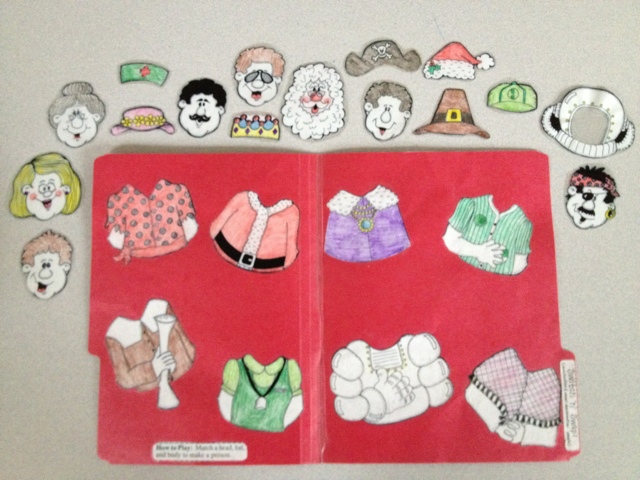
This game is one of my favorites.  This is an opposites game and the kids have to match night and day, up and down, tall and short, etc.  


Sunday, September 30, 2012

Classroom Rules

It's important that children know what their boundaries are without having TO many rules.

In our Pre-k classroom we have three simple rules to follow.

1. Keep yourself safe
2. Keep your friends safe
3. Keep your things safe

We frequently discuss these rules during group discussions and remind the kids what each one means.  If the children are standing on blocks we remind them that they need to make sure they are keeping their things safe.  If they are are running in the classroom, we remind them that they are not keeping themselves safe.  If they are putting their hands on their friends, we remind them they are not keeping their friends safe.  It's important to use similar language when discussing what behaviors the children are showing.

I know its hard but I really try not to say "because I said so" if a child asked why can't I stand on the blocks etc.  By clearly saying because you are not keeping you things safe they understand that they are breaking one of the three rules of the classroom and that the rules are in place to keep them safe. 

A few other good rules for young children include:

Use walking feet inside
Make sure to keep your hands nice
Use your words 


Forign Language

Kids are like little sponges and there is no time like the present to teach a anything and everything you can.  Your only limitation is yourself and how much you are willing to teach yourself in order to teach the kids. 

My son is 14 months old and when he wants more of something at meals he used to scream.  When he was younger I started to show him the sign for more while saying the word.  When he repeated the word or the sign I would clap and give him more.  Now he signs more when he wants more without being prompted.  

Easy ASL signs include:

More
http://www.babysignlanguage.com/wp-content/uploads/signs/more.jpg

Thank you
http://www.babysignlanguage.com/wp-content/uploads/signs/thank-you.jpg

Please
http://www.babysignlanguage.com/wp-content/uploads/signs/please.jpg

All done
http://www.babysignlanguage.com/wp-content/uploads/signs/all-done.jpg

 (Thank you google images for the sign descriptions)

In our class the kids love to sign the ABC's.  Our one rule is that every student tries every time we practice, and practice really does make perfect.  In no time at all the kids were really starting to grasp the letter formations and were able to keep up with the song! Depending on how into signing your group is you could continue on and teach signs for animals, and other keywords that go with themes in the classroom!

Other easy language skills to teach include counting in other languages.

Our children count 1-10 in english, then spanish, then french.  They love it!

I could go on but the point is that if the children are enjoying themselves and you are willing to be patient and teach some new skills then go for it! The sky is the limit! 

Let the children be the stars of the show!

Attention.  Kids want it, need it and thrive when they get it.  In my experience children love anything that singles them out as the star even if its just for a moment.

During our morning meeting (circle) time we choose two students that have been nice friends, great listeners, and a "bucket filler" all morning.  These students get to sit in the special chairs for all of circle.  The kids LOVE when they are chose to sit in the chairs.  


It might be a song:

Good Morning, Good Morning, Good Morning Kati
Good Morning, Good Morning
And how are you?

Kati, Kati Jump up and down
Turn all around
Touch the ground
Kati, Kati Jump up and down
Go ( sit down, to snack, go to centers)

Sing hello to Kati, Kati, Kati
Sing hello to Kati
Sing Hello

 tune: Do You Know the Muffin Man
 Do you know this friend of mine
This friend of mine
This friend of mine
Do you know this friend of mine
His/her name is <name>

Yes I know this friend of yours
This friend of yours
Yes I know this friend of yours
His/her name is <name>

tune: If you're happy and you know it
(Child's name)'s here today, shout hurray!
(Child's name)'s here today, she will learn and laugh and play,
Oh (Child's name)'s here today shout hurray!

Another great way to make the children feel special is to do special activities on specific days.  One that we do is Show n' Share.  We have a specific letter that we are working on every week and so every Tuesday we have a Show n' Share with that letter before lunch.  We call each child and they make a big deal going to their cubbies and hiding their show n' share behind their backs before proudly displaying it to their classmates.  Its a great way to make them feel special while reviewing words that start with the letter of the week! 

Wall Displays!

Wall Displays are my favorite part of walking into any classroom.  The best rooms are the ones that are full of color, have work that showcases the child's ability, and of course have symmetrical and visually appealing wall displays!

Here we go there are a lot of wall displays we frequently change our artwork!

Theme: KINGS, QUEENS, AND FAIRY TALES


For the kings, queens and fairy tales theme we wanted to ask an open ended question to illicit a creative and thoughtful response.  When asking an open ended question it's important that the question isn't to specific or to broad. 


Theme: OCTOBER 


 I just think this is amazing.  My co-teacher is ridiculously talented! I am lucky to work with two very creative, motivated and talented teachers :)

Friday, September 28, 2012

Positive Reinforcement!

The goal of positive reinforcement is to change undesired behaviors by positively reinforcing the good ones.  This could be with a high five, a smile, a sticker, a hug, clapping etc.  It doesn't have to be a physical reward and you can definitely get creative with this.

This is our current behavior plan:


We started by reading the story Have You Filled a Bucket Today? Basically the premise of the book is that everyone in the world has an invisible bucket that needs to be filled up with good thoughts.  You can fill a bucket by being a good friend, using your manners, using kind words or any other kind gesture.


After we read the story we had each of the children create their own bucket:


and then we made a collaborative class list how each child can fill and dip into each others buckets:


We then purchased a silver bucket that mirrored the appearance of the one in the story, drew a face on it and started a "good thought bucket" of our own.   Whenever the kids are "caught" filling a bucket they are asked to add a good thought in the bucket.  Our "good thought" is a pom- pom that we keep in a bucket nearby.  Your good thought could be anything! This is awesome because you can really focus on the desired behaviors that the kids are struggling with! This week for us we are working on manners, covering our mouths so we don't spread germs, and sharing with our friends.  When the kids dip into each others buckets with tattling, invading personal space (popping each others bubbles) or any other behavior that is not desired they have to take a good thought OUT of the bucket.


As a class we chose a goal (10 good thoughts) and a reward (a bike day, where all the kids can bring their bikes to school and can ride them during outside recess time).  If 10 becomes to easy then you can re-negotiate the terms.

Behavior Management Plan: 


I created this behavior chart to map behavior for children in need of special attention to what time of the day certain behaviors are exhibited.  It is not something that is necessary for all of the children but a good back up plan if nothing else is working.  After each time interval has passed I call the child over and discuss their behavior and what we have added to the sheet for that activity.  This way the child is aware of what their parents will be reading and is held accountable for his/her actions.  If the child recieves a number higher than 5 they are given a sticker to put on the chart next to that activity.